STEM at home
An Easy Ramp Experiment for Curious Kids
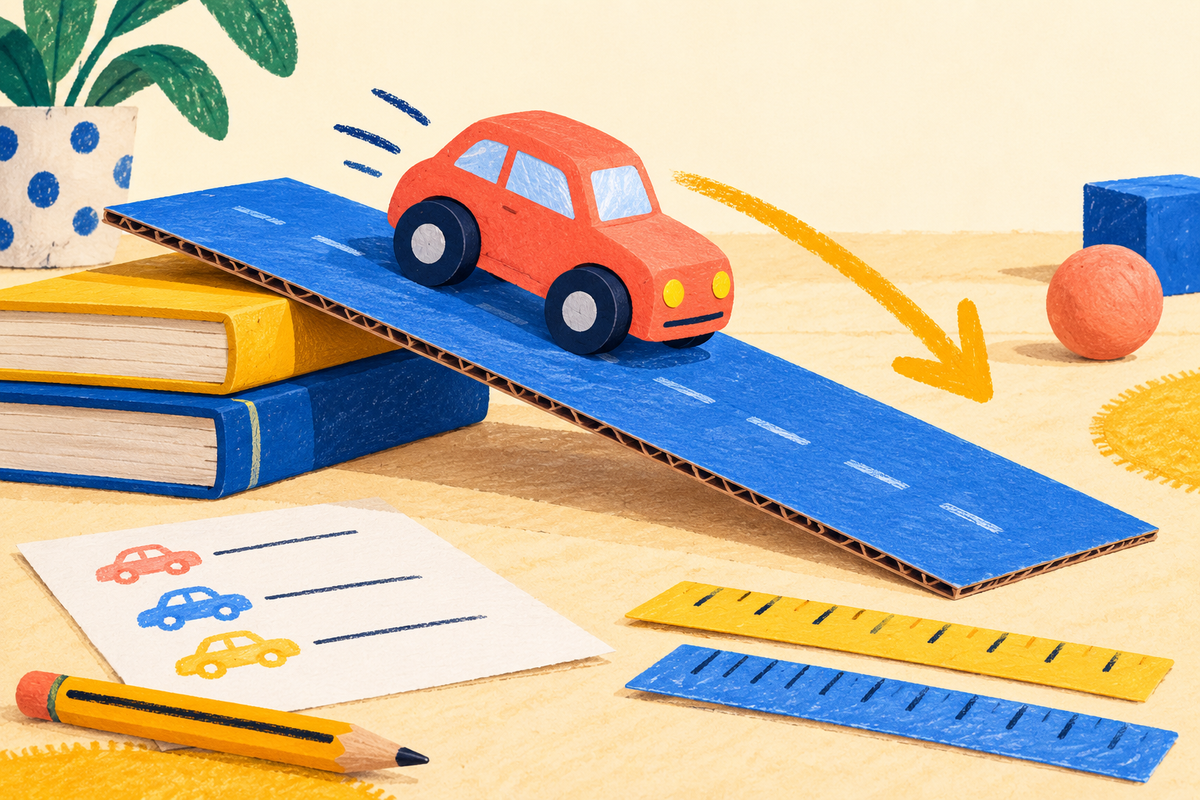
A board, a chunky toy car and one good question can turn a few spare minutes into a small experiment. This simple ramp activity invites children to predict, try something and notice what changes.
Allow about 10 minutes. Gather a stiff piece of cardboard or a short board, one or two books, a large toy car and a clear patch of floor. Choose a toy suitable for your child’s age and stay together while you play.
Build a little slope
Rest one end of the board on a book and leave the other end on the floor. Keep it low and steady. Before letting the car go, trace the ramp with a finger and ask, “Which way do you think it will move?”
Let your child answer with words, a gesture or a drawn arrow. A prediction is simply an idea about what might happen. It does not have to be correct to be worth trying.
Let it go, then look
Place the car near the top and release it without a push. Watch where it travels. Try again from the same place. If it sticks, check for a bent board or a wheel that cannot turn.
Gravity pulls the car downward. On a slope, part of that pull acts along the ramp. The surface and the wheels also affect how it moves.
Change just one thing
Add one book to raise the ramp a little. Keep the car and starting position the same. Ask, “What do you think will happen this time?” Compare the two runs. A steeper ramp may make the car move faster, but the result depends on the setup. Let what you actually see lead the conversation.
- Try a gentler slope, then a steeper one.
- Mark the stopping place with a strip of paper and compare the next run.
- For another experiment, keep the slope the same and try a different surface.
Give the movement a picture
Draw the ramp together. Your child can add an arrow for the car’s journey, invent a destination or sketch a new route. You have moved from a real experiment to a picture that tells its story.
Make it fit your child
For younger children: focus on watching, pointing and taking turns. Use large objects and keep the setup simple.
For older children: invite a before-and-after drawing, compare stopping distances or ask how they could make the test fairer. Changing one thing at a time makes comparisons easier.
Finish whenever interest fades. One thoughtful try is enough. You can always come back to the question tomorrow.
For more invitations to predict, draw and wonder, explore the Tinker & Twirl STEM bookshelf.