STEM at home
Design a Playground on Paper: A Creative Activity for Kids
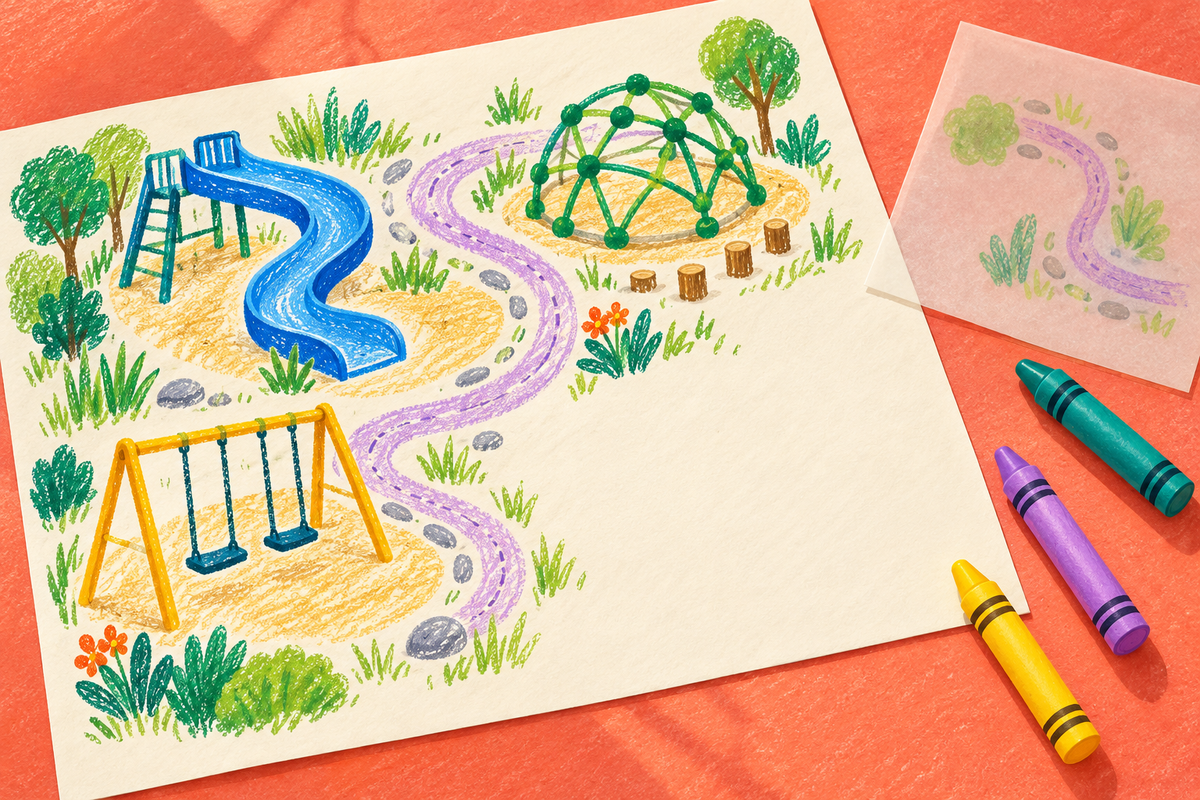
Designing a playground on paper is a drawing activity in which your child chooses places to play, connects them with paths, and changes the plan as new ideas appear. Start with a blank sheet, crayons, and one question: what would you like to do here?
The finished drawing might have a very long slide, a quiet corner, or a climbing shape that looks like a dragon. Leave room for your child's own choices. A few marks can be enough to start a conversation.
What you need
- A large sheet of plain paper
- Crayons or washable markers suitable for your child's age
- A second sheet for trying another idea
- Optional tracing paper for older children, with adult supervision
Keep the setup simple. Younger children can make marks while you describe the imaginary places they suggest. Older children can draw the plan themselves and add symbols or labels if they want to.
1. Choose a place to begin
Ask your child to name one thing they would enjoy in an imaginary playground. Draw that idea first. A slide might begin as a curved line; a place to sit might be a circle; a garden could be a patch of colorful marks.
Avoid drawing the whole playground for them. If they want help, offer to draw one requested part and let them decide what comes next. There is no required list of equipment to include.
2. Leave space for another idea
Look at the empty areas of the paper together. What could fit beside the first drawing? Try a second place with a different purpose: somewhere to move, somewhere to look, or somewhere to rest.
For a playful twist, ask what an imaginary visitor might enjoy. A tiny bird could want a perch. A giant could need a very large seat. These are invitations to invent, rather than requirements to complete.
3. Connect the places
Draw a path between two parts of the playground. It can be straight, curved, wide, or wiggly. Trace the route with a finger and describe the journey: start here, go around this shape, and finish over there.
Ask a specific question about the drawing. Where would you turn? Which path goes past the garden? Could you draw a second way to get to the same place? Let your child point, draw, or tell you their answer.
4. Try one change
Choose a small part to revise. Perhaps the path could bend around a tree, the quiet corner could move, or a new place could fill an empty space. Make the change on a second sheet, or use supervised tracing paper to sketch another route.
Compare the two drawings without choosing a winner. What stayed the same? What changed? Which version would your child like to explore in a story? The point is to notice choices and try another possibility.
Adapt the activity for different ages
Ages 1–4: Stay alongside your child, use large paper and age-appropriate drawing materials, and follow their marks and words. Offer one simple choice at a time, such as a straight path or a curvy path. Keep loose scraps and optional tracing materials away from children who mouth objects. Short shared drawing moments are enough.
Ages 4–8: Invite your child to create a route, compare two layouts, or add simple symbols. They might draw a key showing which color means a path or a resting place. Keep labels optional; pointing and storytelling work too.
Let the design stay open
You do not need to correct the drawing into a realistic park. Ask about the parts your child notices and give them room to change their mind. NAEYC's guidance on exploratory art encourages choices and exploration rather than copying a predetermined finished example.
To continue the idea, turn the drawing into a story using our five playful storytelling steps, or try a separate hands-on building invitation with our paper bridge activity. Browse the Tinker & Twirl bookshelf if your child enjoys combining drawing, coloring, and imaginative play.
Before putting the paper away, ask for one last addition. It could be a new route, a silly sign, or a place that nobody has named yet.