Color & play · Creative activities
Make a Make-Believe Window: An Indoor Drawing Activity
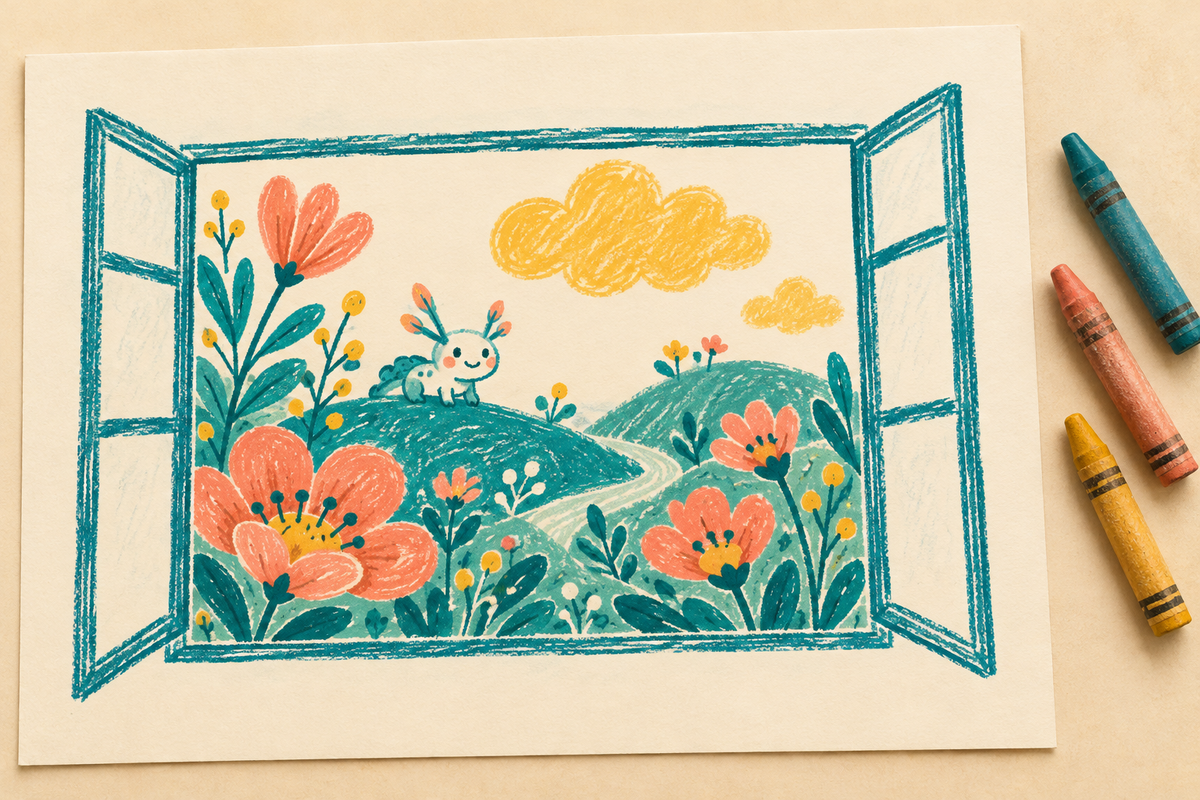
A make-believe window is a rectangle on paper with an imaginary view inside it. Your child might draw a garden above the clouds, a cosy creature's home or somewhere that has not been named yet. This indoor drawing invitation needs only paper and age-appropriate crayons. The window gives the picture a small starting place while leaving the view entirely open.
Put out a simple drawing invitation
Choose a plain sheet and a few crayons or washable drawing tools suitable for your child's age. Work on a clear, protected surface and supervise as needed. You do not need to cut the paper, use a real window or tape anything to glass. For a younger child, larger paper and chunky crayons may be easier to handle; keep small loose supplies out of the activity.
Invite your child to draw a window outline, or ask whether they would like you to make one. A single large rectangle is enough. Leave the space inside blank. It can also be a round porthole, an arch or a wobbly shape. The outline is an invitation, not a shape exercise that needs correcting.
Choose somewhere to look
Try one opening question: “If this window could look anywhere, what might we see?” Pause and let your child choose. If they want a starting point, offer two possibilities: somewhere quiet or somewhere busy, above the ground or under the sea. They can pick something else, combine the choices or begin with a colour instead.
You can look at an ordinary view first and imagine changing just one thing. A tree might have striped leaves; a cloud might become a floating doorstep. There is no need to reproduce what is actually outside. Avoid making a finished example for your child to match. A few marks can become their whole view.
Build the view in three small choices
- Choose a background. Leave the paper white or add a patch of colour for sky, water, ground or something invented. Ask before offering more colours.
- Add one thing to notice. A flower, a creature, a doorway or a curious shape can be the focus. Your child decides how large it is and where it belongs.
- Leave a possibility. An empty corner might stay empty, hold something small or become a place to return to later. Filling every part of the rectangle is optional.
If your child prefers making marks over drawing recognisable objects, follow that direction. A yellow swirl and three blue lines can be the view. You do not have to name them. Instead of guessing what a shape represents, try, “Would you like to tell me about that part?”
Try a second view without starting over
When your child wants another idea, turn the paper and imagine looking through the same window at a different time. What changes when it becomes windy, dark or wonderfully strange? They might add a moon, move a cloud or draw a second window on another sheet. Keep this as an optional invitation rather than another set of steps to complete.
A child who enjoys details could draw something near the window and something far away, or add a small clue about who lives in the imagined place. A younger child might enjoy one big shape and a favourite colour. These are different ways into the activity, not age tests or promised learning outcomes.
Keep the drawing theirs
If you join in, use your own sheet. Ask before adding a mark to your child's page. You can hold the paper still, listen to an idea or demonstrate a requested shape on spare paper. Our guide to drawing together without taking over has more ways to offer help with permission.
Finish when your child wants to stop. If they want a title, write down their own words with permission. The picture can stay unfinished or become the first view in a small collection. For another colour-led invitation, explore our warm and cool colour activities.
Want to begin from an existing picture another day? Browse Tinker & Twirl for drawing and colouring ideas, checking the age range and availability of the edition you choose. A familiar character can look out at a place your child invents. The interesting part is the view they choose.