STEM at home
Flashlight Shadow Play for Kids: Make It Big or Small
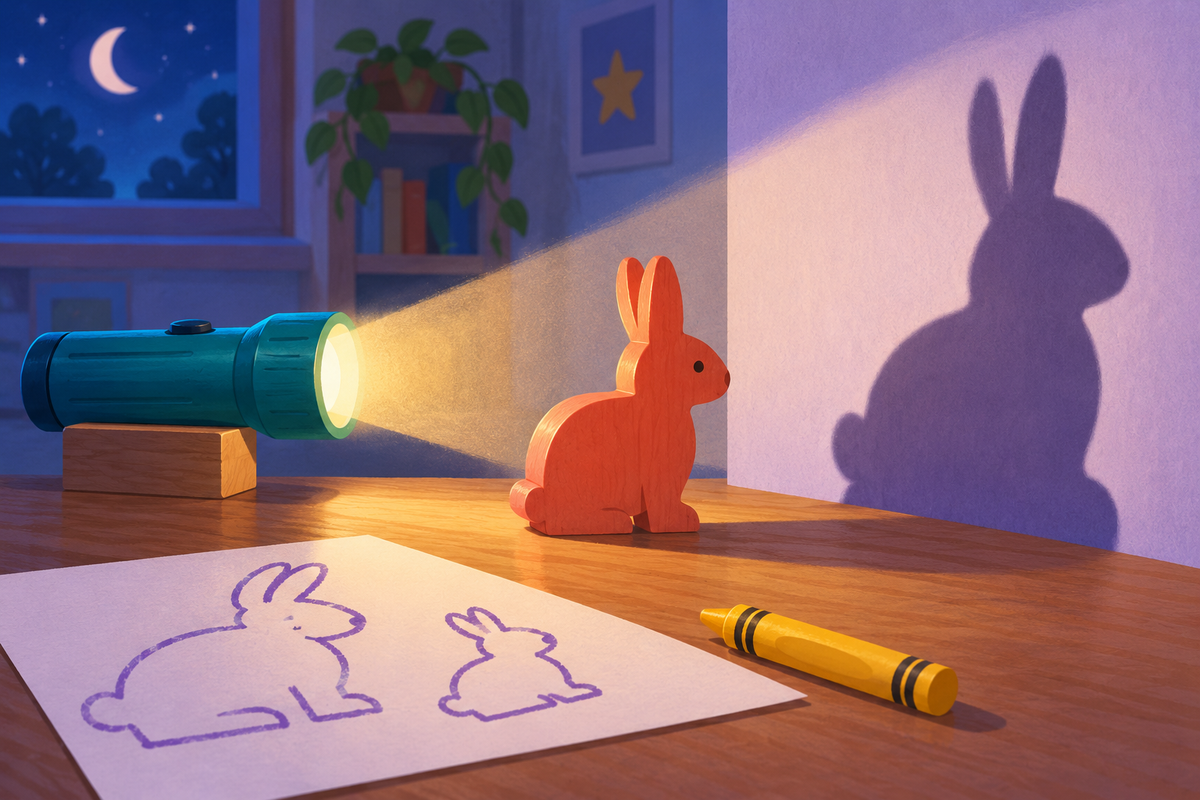
Flashlight shadow play is a simple indoor activity: shine a light at a plain wall, put a large solid object in the beam, then move the object and watch its shadow change. Start with one toy or block. Add paper and crayons when your child wants to record what they notice or turn an outline into a character.
Set aside about 10 to 15 minutes, with permission to finish sooner or keep exploring. You do not need a completely dark room or a collection of special materials.
What you need
- A cool LED flashlight with a securely closed battery compartment
- A plain, light-colored wall or a large sheet of white paper
- One or two large, solid objects, such as a wooden block or a chunky toy animal without detachable pieces
- Paper and chunky crayons
- Optional: a stable support for the flashlight and a ruler for older children
Keep the floor clear and leave enough room light to move safely. An adult should handle the flashlight for toddlers and keep the beam away from everyone's eyes. Keep batteries and small loose parts out of reach. If a dim room feels uncomfortable, try the activity in an ordinary lit room with the flashlight closer to the wall.
Make one shadow, then change one thing
1. Find the outline
Aim the flashlight at the wall. Place your object between the light and the wall, inside the beam. Let your child point to the object and its shadow. Ask, “Which part looks like the ears?” or “Can you find the top of our block?” Keep the first conversation about what is visible.
2. Try a bigger and a smaller shadow
Keep the flashlight and wall in the same positions. Slowly slide the object toward the flashlight, then back toward the wall. Pause at each position so your child can compare. Before the next move, invite a prediction: “Where would you put it to make the shadow bigger?”
3. Return to the starting place
Ask your child to make the first shadow again. This little challenge gives the experiment a clear finish: can they choose a position that produces a similar outline? Older children can mark three object positions on a sheet of paper beneath the setup and repeat the comparison.
4. Rotate the object
Now keep the object's position roughly the same and turn it sideways. A toy animal's recognizable outline might become a narrow shape. Try guessing which way the object is facing from its shadow. Change distance and rotation separately so the comparisons are easier to follow.
Why does the shadow change size?
A solid, opaque object blocks light, leaving a shadow on the wall behind it. With the flashlight and wall fixed, moving the object closer to the flashlight generally makes the shadow larger; moving it toward the wall makes it smaller. The toy itself has stayed the same size. Science Buddies' explanation of light and shadow describes this effect and how changing an object's angle changes its outline.
For children, a useful explanation is simply, “We moved the toy, and the shadow changed.” Invite them to test it again rather than expecting them to memorize a rule.
Adapt the activity for your child
Ages 1 to 4: spot, choose and watch
Offer two large objects and let your child choose one. You manage the light and move the object slowly while they point, name shapes or ask for another turn. A few changes may be plenty. For a child who enjoys drawing, offer paper afterward and invite any marks inspired by the shadow. Accurate tracing is optional.
Ages 4 to 8: predict, compare and draw
Try three positions and sketch the outline seen at each one. If measuring sounds interesting, measure each shadow's height on paper held flat against the wall. Keep the light fixed and the same object upright for every comparison. Ask which result they expected and which surprised them.
Turn the experiment into an imaginary scene
Draw a big outline and a small outline on a fresh sheet. What could connect them? Perhaps a tiny rabbit meets a giant rabbit, or a small tower has an enormous doorway. Your child can add a setting, patterns and colors. The illustration above shows one possible setup and drawing idea; the finished scene can look completely different.
For another experiment with one change at a time, try our easy ramp activity. For a building challenge, explore the paper bridge activity. You can also browse the Tinker & Twirl bookshelf for drawing and activity ideas to continue the play.